

Dehkordi v. O’Dell, 2025 ONSC 6654
If you’ve ever wondered whether the way you strike out a clause in an Agreement of Purchase and Sale matters, a recent Ontario Superior Court decision provides a stark reminder: it absolutely does. In Dehkordi v. O’Dell, Justice Mathai awarded the vendors over $260,000 in damages after finding that financing and inspection conditions were completely removed from the agreement, despite the purchaser’s creative arguments to the contrary.
The Facts
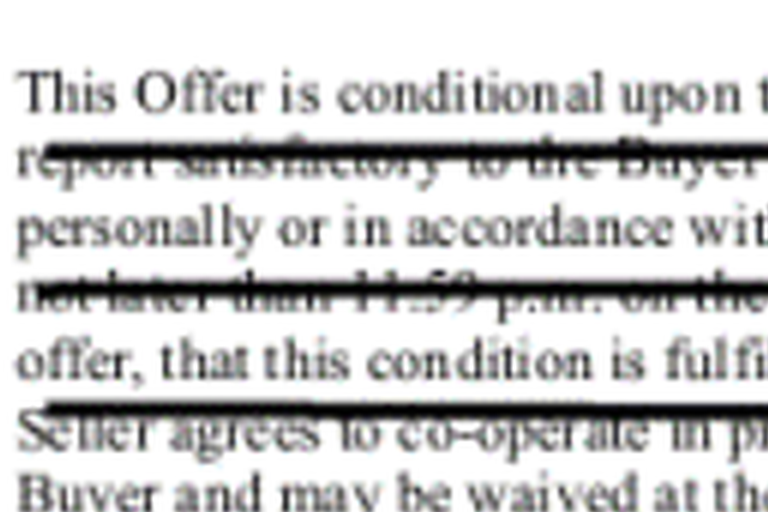
In June 2022, during what the court described as a “hot” seller’s market, the purchaser’s agent prepared an offer on the vendors’ property for $1,600,000. The offer included standard inspection and financing conditions in Schedule A. However, the agent edited these conditions by placing three horizontal lines through every second line of each condition.
After negotiations, the parties agreed on a purchase price of $1,640,000 with a closing date of August 17, 2022. The purchaser paid an $80,000 deposit and later obtained two extensions of the closing date. Despite these extensions, the purchaser was unable to secure financing and the deal collapsed on September 30, 2022.
The vendors re-listed the property and eventually sold it for $1,381,000, resulting in a loss of $259,000 from the original agreement.
The Dispute
The purchaser sued multiple parties, claiming the agreement was conditional on financing and inspection. His theory? Rather than having diagonal lines crossing out the section, the agent had only drawn a few horizontal lines. The purchaser attempted to argue that only those specific lines were removed, and the conditions were not removed entirely. Therefore, he argued, he was entitled to walk away from the deal without penalty when he couldn’t obtain financing.
The vendors and the purchaser’s former lawyers moved for summary judgment, arguing the conditions were completely struck out and the agreement was unconditional.
The Court’s Analysis
Justice Mathai systematically dismantled the purchaser’s position, finding no genuine issue requiring a trial.
First, the court examined what remained of the conditions if only the struck lines were removed. The result was what the judge described as “awkward,” “incomprehensible” and “gibberish.” The financing condition, for example, would have read: “This Offer is conditional upon the Buyer arranging, at the Buyer’s own expense, a new Mortgage satisfactory to the Buyer in the Buyer’s sole for the delivery of notice… Seven banking day be null and void…”
The court held that the only common-sense interpretation was that the conditions were intended to be removed entirely.
Second, the factual matrix contradicted the purchaser’s position. The vendors had already purchased a new home with an August closing and needed an unconditional sale. Their agent confirmed the offer was unconditional. The purchaser’s own agent testified that the purchaser instructed him to remove the conditions. Perhaps most tellingly, the purchaser had made a previous offer on a different property in June 2022 where the same conditions were struck out with an “X”, demonstrating he was comfortable making unconditional offers.
Third, the purchaser’s conduct was inconsistent with him genuinely believing the agreement was conditional. He never retained a home inspector. During three months of extension negotiations, he never once asserted the agreement was conditional. He only raised this argument for the first time in October 2022, i.e., after the deal collapsed and the vendors were seeking compensation.
Key Takeaways for Transactional Lawyers
- Clarity is Everything: This case underscores the critical importance of clear, unambiguous drafting in real estate agreements. If you intend to edit a condition rather than remove it, rewrite it cleanly. Don’t rely on strikethroughs that leave room for interpretation.
- Initial All Changes: The court noted that accepted real estate practice requires initialing every change in an offer. If only certain lines were being deleted, the purchaser’s initials should have appeared next to each deleted line, not next to the entirety of the conditions.
- Document the Intent: When conditions are being modified or removed, consider adding a notation or using clearer editing methods. An “X” through an entire clause, or better yet, simply deleting and retyping, leaves no ambiguity.
- The Factual Matrix Matters: While contract interpretation focuses on the text, courts will consider the surrounding circumstances. Market conditions, prior dealings, and the parties’ conduct all informed the court’s conclusion that this was meant to be an unconditional offer.
- Summary Judgment Works: This case also demonstrates that even contract interpretation disputes can be resolved on summary judgment when the evidence is clear and there’s no genuine issue requiring a trial.
The Bottom Line
The purchaser’s argument that horizontal lines through every second line meant something different than an “X” through a clause ultimately cost him over $260,000 in damages (plus $45,000 in costs to the various defendants).
For transactional lawyers, the lesson is simple: when drafting or reviewing offers, ensure that any modifications to standard clauses are crystal clear. What seems obvious to you may become the subject of expensive litigation if the deal goes sideways. And as this case shows, creative interpretations of strikethroughs are unlikely to find favour with the courts when common sense points in the other direction.
